
Regulations
18th Edition Wiring Regulations Guide
A guide to the 18th Edition Wiring Regulations: what BS 7671 is, how it differs from the On-Site Guide, who needs the qualification, which course to take, how the exam works, Amendment 4:2026 and how it fits with ECS requirements.
On this page
01
What is the 18th Edition?
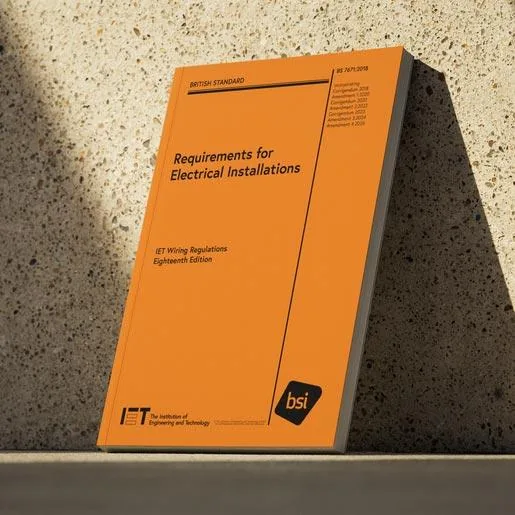
The 18th Edition is the everyday name for BS 7671, the UK national standard for electrical installations. Its full title is BS 7671: Requirements for Electrical Installations.
Electricians also call it the Wiring Regulations, the 18th Edition or simply “the regs”. It is used for the design, installation, verification and maintenance of electrical installations within its scope.
The latest publication is BS 7671:2018+A4:2026, commonly called the Orange Book. Amendment 4 was published on 15 April 2026.
Which version of BS 7671 is current in October 2026?
Amendment 4 is the latest publication. During the six-month transition, the previous Brown Book version — BS 7671:2018+A2:2022 plus Amendment 3:2024 — remains valid until 15 October 2026. After that transition, Amendment 4 is the version to use.
You are not expected to memorise the whole book
BS 7671 is a reference standard. A major part of Wiring Regulations training is learning how the book is structured and how to find the relevant requirement efficiently.
Completely new to the trade? Our How to Become an Electrician guide explains the wider qualification route.
02
BS 7671 vs the On-Site Guide: what is the difference?
They are related, but they are not the same book. BS 7671 contains the requirements. The IET On-Site Guide is supporting guidance designed to make common installation information easier to use in practice.
Which book do you need for the 18th Edition exam?
For City & Guilds 2382-26, the assessment is based on BS 7671:2018+A4:2026. City & Guilds lists BS 7671 as the required reference material for the exam.
Can you use the On-Site Guide in the 2382-26 exam?
No. The City & Guilds handbook says the examination is based on BS 7671 only. The On-Site Guide is useful supporting guidance, but it is not the permitted exam reference for 2382-26.
The current On-Site Guide is the 9th Edition and is aligned with Amendment 4:2026.
03
Do you need the 18th Edition?
It depends on your role and qualification route. Understanding BS 7671 is fundamental for people designing, installing, maintaining or verifying electrical installations, but a stand-alone 18th Edition award does not make somebody a qualified electrician.
Brand new to the trade
You can take a Wiring Regulations qualification, but do not mistake it for a complete electrician route. New entrants still need the recognised technical and workplace competence route for qualified status.
Apprentice or improver
BS 7671 training commonly sits within wider electrotechnical training and helps you understand the requirements behind the work you are learning on site.
Qualified electrician
Keeping Wiring Regulations knowledge current is important for competent work, and employers, schemes or ECS requirements can ask for a recognised current BS 7671 qualification.
Older 18th Edition certificate
An older certificate may still show previous training, but whether it meets a current employer, scheme or ECS requirement depends on the rules that apply when you use it.
Can a beginner take the 18th Edition?
Yes. City & Guilds lists no formal entry requirements for 2382-26 and approves the qualification for learners aged 16 and over. Its handbook says it is primarily aimed at practising electricians and allied professionals, but it is also suitable for anyone who wants to demonstrate an understanding of the 18th Edition. In practice, some basic electrical knowledge makes the material much easier to understand.
Is the 18th Edition law? No. HSE describes BS 7671 as non-statutory regulations and a widely recognised code of practice. Following it is a well established way of helping to demonstrate compliance with relevant parts of the Electricity at Work Regulations 1989, but BS 7671 itself is not an Act of Parliament.
04
Which 18th Edition course should you take?
If you are booking a stand-alone Wiring Regulations qualification now, make sure it is aligned with BS 7671:2018+A4:2026. The main current options include City & Guilds 2382-26 and EAL's updated Level 3 Award.
City & Guilds
2382-26
Level 3 Award in Requirements for Electrical Installations BS 7671:2018. The current unit covers Amendment 4:2026 and is assessed by one multiple-choice online test.
EAL
Level 3 Award
EAL qualification 610/7005/1 covers BS 7671:2018+A4:2026. It has one 35-hour knowledge unit and an open-book, 60-question on-screen examination.
Do not accidentally book the outgoing assessment
City & Guilds 2382-22 is the previous qualification version. Its last registration date was 31 July 2026 and the final opportunity to sit the older online test is 15 October 2026. If you are starting a new stand-alone course, look for the Amendment 4 version.
Do you have to attend a training course?
Not always. ECS says assessment-only options for the BS 7671 qualification are available from some approved training providers. Some centres restrict exam places to learners who trained with them, so check the provider's booking rules before assuming you can book the assessment on its own.
05
What does the course actually teach you?
The qualification is about understanding the content and application of BS 7671. It teaches you how to navigate the standard and apply its requirements; it is not a substitute for the practical training and workplace competence needed to become an electrician.
How the book is laid out
You learn where the main sections are and how to move around BS 7671 without trying to memorise every page.
Electrical safety
You learn how the Wiring Regulations are used to reduce risks such as electric shock, fire and damage to electrical installations.
Choosing and installing equipment
You learn how the regulations affect the equipment, cables and protective devices used in different situations.
Inspection and testing
You learn where the regulations cover checking electrical work and recording the results.
Special locations
You learn that some places have extra requirements, such as bathrooms, EV charging locations and medical areas.
Finding the right answer
A big part of the course is learning how to use the contents, index and sections quickly enough to find the regulation you need.
06
What is the 18th Edition exam like?
For City & Guilds 2382-26, you sit one online, open-book, multiple-choice assessment. The exam is based on BS 7671:2018+A4:2026.
Questions
60
Multiple choice
Time
120 min
Two hours
Format
Open book
BS 7671 required
Pass mark
Approx. 60%
City & Guilds handbook
What can you take into the 2382-26 exam?
Permitted in the BS 7671 book
• Blank or numbered bookmarks / tabs to identify chapters.
• Highlighting.
• Short cross-references to another part of BS 7671.
• A non-programmable calculator is also required.
Not permitted
• Sample exam questions or answers.
• Detailed written notes.
• Added diagrams or material that could help answer questions.
• Other reference books such as the On-Site Guide for the 2382-26 assessment.
Open book does not mean easy. With 60 questions in two hours, the useful skill is recognising what the question is asking and finding the relevant part of BS 7671 efficiently.
EAL's Amendment 4 award is also assessed by an open-book, 60-question on-screen examination. Always follow the exact joining instructions from your awarding organisation and assessment centre.
07
How should you prepare for the exam?
The strongest preparation is becoming quick and confident with BS 7671 rather than trying to memorise hundreds of regulation numbers.
Learn the book layout
Know what the main parts cover so you have a good idea where to look before you start searching.
Use the contents and index
Practise turning a question into the right search word, then follow the references to the correct section.
Practise against the clock
Open book does not mean unlimited time. Use timed practice so looking things up becomes quicker.
Read the question carefully
Do not rush straight into the book. First work out exactly what the question is asking.
Use the current book
For City & Guilds 2382-26, study from BS 7671:2018+A4:2026 so your revision matches the assessment you are taking.
Understand rather than memorise
Knowing where and how to find an answer is more useful than trying to remember hundreds of regulation numbers.
Check the exact exam rules before the day. City & Guilds permits limited highlighting, bookmarks and short cross-references, but detailed notes are not allowed. Your centre is responsible for checking that your copy of BS 7671 is acceptable.
08
What changed in Amendment 4:2026?
Amendment 4 is a major update to the 18th Edition. Changes run throughout the standard, but the IET highlights four particularly important areas.
Stationary secondary batteries
A new chapter covers stationary secondary batteries used for electrical storage and the supply of electrical installations.
Power over Ethernet (PoE)
A new section covers systems that transmit electrical power over telecommunications cabling alongside data.
Functional earthing and bonding for ICT
A new section covers functional earthing and functional equipotential bonding for information and communication technology equipment and systems.
Medical locations
Section 710 has been significantly revised, including changes around supplementary protective equipotential bonding and associated test records.
Do you need to memorise every Amendment 4 change?
No. For the 2382-26 qualification, the important skill is understanding the content and application of the current standard and knowing how to find the relevant requirements. Amendment 4 contains many more changes than the four headline areas above.
09
What happens after you pass?
Passing the 18th Edition shows that you have been assessed on your understanding of the Wiring Regulations. It can support your wider qualification route, employment and ECS requirements, but it does not prove occupational competence on its own.
18th Edition
Wiring Regulations knowledge
Shows that you have passed a recognised knowledge assessment covering BS 7671.
Qualified status
Your wider Level 3 route still matters
Occupational qualifications and practical competence assessments are what demonstrate the wider ability required to work as a qualified electrician.
ECS
Current Wiring Regulations can be required
ECS requires a recognised BS 7671 qualification for current Installation Electrician Gold Card routes, with specific rules depending on the type and history of the application.
Does the 18th Edition qualification expire?
The important issue is currency. BS 7671 is amended over time, so a certificate gained against an older version does not automatically prove that your knowledge is up to date with the latest requirements. Employers, schemes and ECS applications can specify the edition they expect you to hold when you apply or renew.
For example, ECS says first-time Installation and Maintenance Electrician Gold Card applicants must hold the current edition of BS 7671 when they apply. Registered Electricians also commit to keeping their Wiring Regulations knowledge up to date. Existing cardholders can fall under different renewal rules, so check the exact ECS route rather than assuming one rule applies to everybody.
Looking for work? Browse current electrical jobs and see what qualifications employers are asking for.
10
Frequently asked questions
More common questions about 18th Edition training and how the qualification fits into the wider trade.
How long does an 18th Edition course take?
There is no single course length. ECS says classroom training can range from around one to five days, while online and self-study options let you work at your own pace. City & Guilds assigns 35 guided learning hours and 40 total qualification hours to 2382-26.
Can I take the 18th Edition exam without doing a course?
Potentially, yes. ECS says assessment-only options are available from some approved training providers. A provider may still choose to restrict its exam places to learners who trained with them, so check before booking.
Is the 18th Edition the same as an NVQ Level 3?
No. The 18th Edition award is a Level 3 knowledge qualification about BS 7671. It is not the same as an occupational Level 3 NVQ or apprenticeship route that assesses the wider knowledge and workplace competence needed to become a qualified electrician.
Is the 18th Edition the same as Part P?
No. BS 7671 is the national standard for electrical installations, while Part P is the part of the Building Regulations dealing with electrical safety in dwellings in England and Wales. They relate to electrical work in different ways and one does not replace the other.
Do electricians have to retake the 18th Edition every time BS 7671 is amended?
There is no universal rule that every amendment automatically requires every electrician to sit a new stand-alone 18th Edition exam. You still need to work to the version that applies, and employers, schemes or ECS applications can require evidence that your Wiring Regulations knowledge is current.
Can I use an older BS 7671 book for the City & Guilds 2382-26 exam?
No. City & Guilds states that the 2382-26 assessment is based on BS 7671:2018 Amendment 4:2026 and lists that publication as the required reference material for the exam.
Source and accuracy
This guide was reviewed against current information from the IET, HSE, City & Guilds, EAL and ECS on 8 October 2026. Wiring Regulations, qualification assessments and scheme requirements can change, so always check the current rules before booking training or making an ECS application.
Electrical Guides
Continue learning
Careers
How to Become an Electrician in the UK
Understand the main routes into the electrical industry and how to work towards becoming qualified.
Qualifications
NVQ Level 3 Electrical Guide
Understand the workplace Level 3 route, what evidence you need and where the final assessment fits in.
Industry Advice
The Complete ECS Card Guide
Understand ECS cards, Gold Card routes and which card may be right for your stage in the trade.
Ready to look for electrical work?
Browse electrical jobs from employers and recruiters across the UK, or create your free profile.